For years, I told myself I wouldn’t create a product unless I saw a real need for it. And over the past few years, a few needs have slowly started showing themselves to me.
The first one I couldn’t get out of my head was this: so many self-taught photographers, like myself, don’t know how to use their camera when they first get one.
Adjusting your settings can feel confusing, sometimes to the point of overwhelm. The kind of overwhelm that makes you say screw it, put your camera away, and start using your phone to mainly take pictures again.
And because I use my blog to document what I learn on my photography journey, I wrote this post to explain why I created Adios Auto Mode (AAM). I hope you can see yourself in this journey or see whether something like AAM can help you on yours!
Disclosure: This post may contain affiliate links. If you make a purchase through them, I may earn a small commission at no extra cost to you.
Starting Photography
I’ve been into photography for over half of my life. I got my first digital camera in middle school after winning a dare to climb to the top of a rock climbing wall.
For years, I was obsessed. But when it came time to be an “adult” after finishing high school, I took a long break from it. Still, photography kept pulling me back.
In 2013, shortly after moving across the country on my own, I picked up my camera again. And boy oh boy, did I feel lost with it.
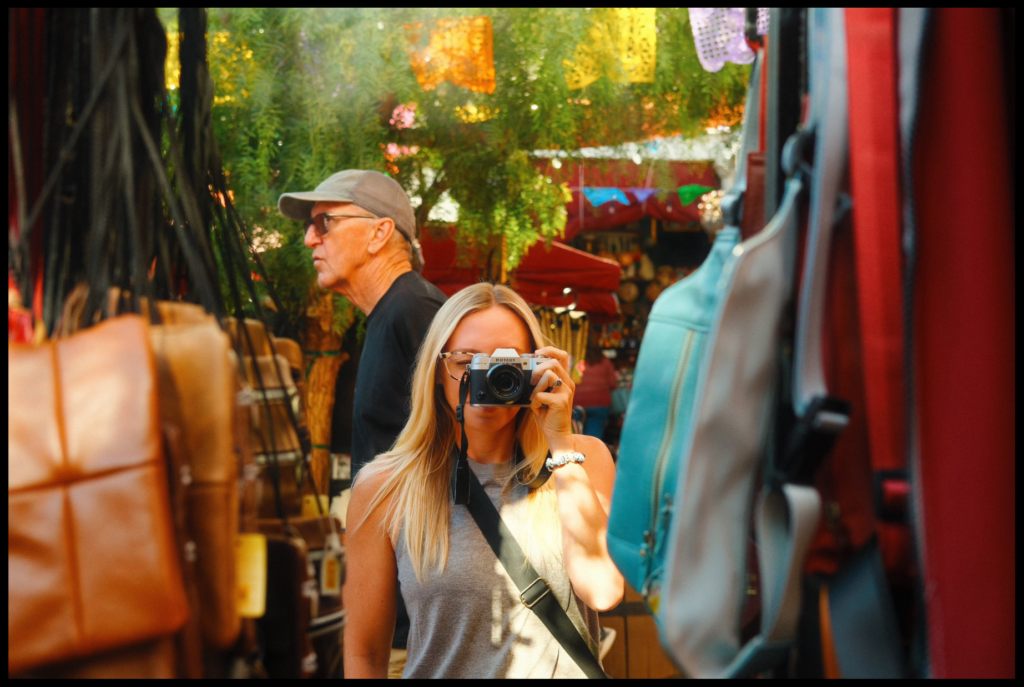
Below is a picture of me taken in 2013, but posted in 2018 when I began @mekennasmoments.
Most of the time, my camera stayed in automatic mode. I had zero confidence in my ability to “get the shot” because if something went wrong, I had no idea why.
Why were people blurry? Why was the background blurry sometimes but not others? Why were some images so grainy?
It’s a little embarrassing to admit not knowing this now, but the truth is, most of us start there. Slowly, I started reteaching myself how my camera worked. The process took way longer than I expected, but eventually things began to click.
New Camera Confusion
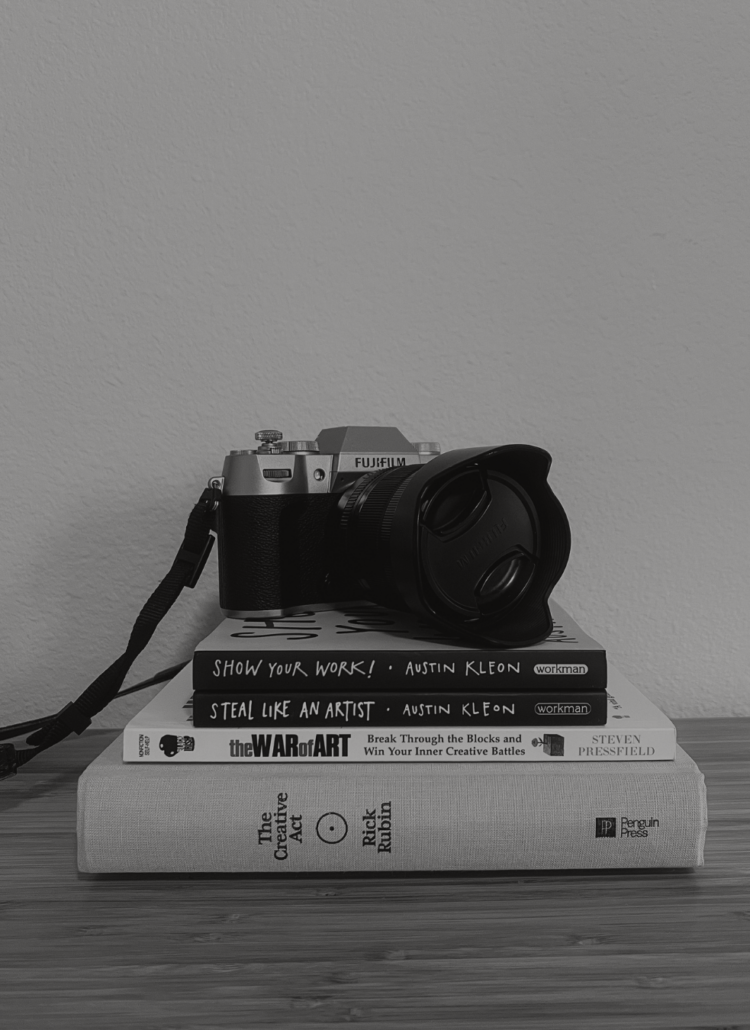
In January 2025, I got my first Fujifilm camera.
And wow… I felt overwhelmed all over again.
It was so different from the Canon and Sony cameras I had used before. I knew how the main camera settings worked, but my entire shooting flow was thrown off.
That’s when it hit me.
There are so many people buying their very first camera right now. Or people who bought one months ago but still have no idea how to actually use it.
And when you’re not obsessed with photography like me, and you just want better photos of your life, your travels, or the moments that matter, not understanding your camera can quickly turn into frustration. And frustration turns into the camera sitting on a shelf.
Again, no shame in using your phone. But if you bought a camera because something in you felt drawn to it, that confusion can stop you from using it at all.
If that’s you, I get it.
If you know your camera is capable of taking better photos but you’re not sure how to make that happen, I want to help.
Recommended read: Fujifilm X-T50: First Impressions and Experience
The Photographer’s Path
Through my own experience and conversations with so many people who reach out to me, saying, “I just got my first camera, and I’m excited, but I have no idea where to start,” — I’ve noticed a pretty common path many photographers take.
It usually looks something like this:
- You feel drawn to pick up a camera
- You start documenting things that matter to you
- You begin learning about composition and light
- Then you hit the settings wall
- Eventually, the challenge becomes staying consistent
Sometimes steps three and four switch places, but most people hit that same wall at some point.
Your photos aren’t coming out how you imagined… and you don’t know why.
Usually by this stage, you’ve already built some photography habits. You’ve proven you care about this. You just need someone to help connect the dots.
Recommended read: How I Owned Calling Myself a Photographer
Learning to Use Your Camera
Technically, you can teach yourself everything about your camera like I did.
But it might take years.
There’s no shortage of photography information online. Tutorials, videos, blog posts, you can learn almost anything for free if you search long enough. But having access to information isn’t the same thing as actually learning how to use your camera.
If you’re like me, information alone doesn’t help. I don’t really understand things until I practice them myself with intent.
Through my background in health sciences and my long-standing obsession with human behavior, I’ve spent years thinking about how people actually learn and build habits. And the truth is, most of us don’t learn by being told everything all at once.
We learn by focusing on the right things at the right time, and by practicing them until they start to stick.
That’s when I realized camera settings didn’t need to feel so complicated. Instead of trying to explain everything at once, I could simplify the process by only focusing on what matters at the beginning and guiding people through practice-based steps that help things actually click.
That idea eventually became a 7-step process. And instead of packaging it into a $500+ course, like many suggest, I decided to write an e-book and offer it at an unbelievably low price… because it felt right.
Each step teaches one concept and then gives you a chance to immediately apply it with your camera. You can repeat steps, stay longer on the ones you need, and come back to them anytime.
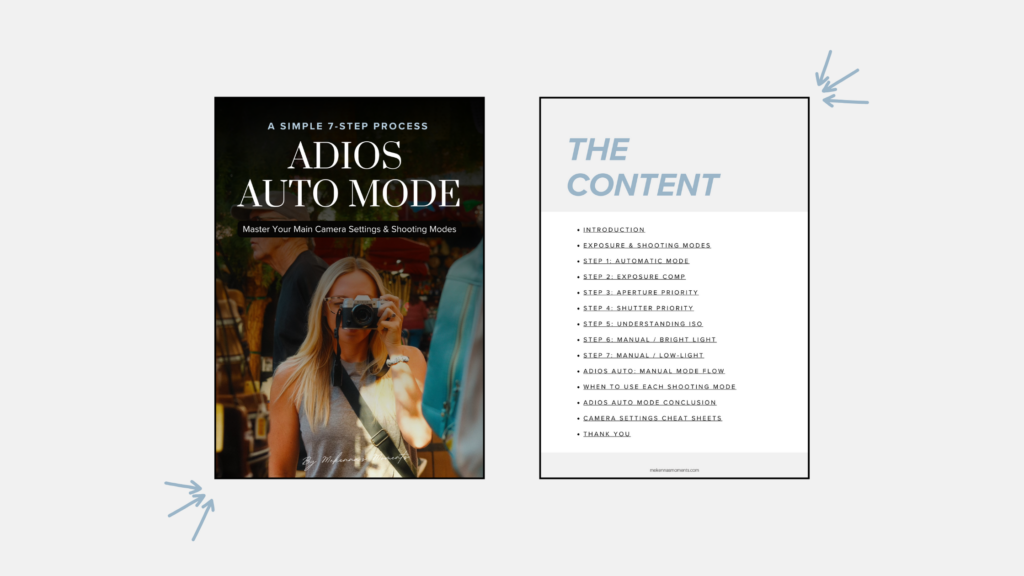
By the end, you’ll gain experience shooting in manual mode — not perfectly, but confidently enough to keep going.
The goal isn’t to teach everything.
The goal is to get you started.
Recommended read: My First Film Camera: The Olympus Stylus
Introducing Adios Auto Mode
And that’s how Adios Auto Mode was born.
This e-book took me over a year to create. I wrote the first version, scrapped it, rewrote it after getting my Fujifilm XT50, and revised it several more times.
Creating something like this for the first time was not easy. But I wanted to build something based on the exact learning process that finally made things click for me.
Inside Adios Auto Mode, I walk you through:
- What actually happens when you take a photo
- The main camera settings responsible for capturing an image
- The main shooting modes on your camera
- How to adjust your main settings and use your shooting modes step-by-step
If you’ve ever taken a photo that came out blurry, grainy, or too bright (and had no idea why), this e-book will help you understand what’s happening and how to fix it.
Adios Auto Mode is for:
- people who own a camera but only use automatic mode
- people who tried manual mode and gave up
- people who have experimented with other shooting modes, but still feel confused
It’s for people who want to document their life with a camera more intentionally.
It’s for the person who bought the camera… and then tucked it away because learning it felt too complicated.
For those who need a guide that helps them create a toolbox for using their camera. People who want to know what setting to adjust when and in what situation whenever they pick up their camera.
Recommended read: The 52-Week Photo Challenge: My Experience, Year With Fujifilm, and Lessons Learned
Final Thoughts
For years, I’ve felt a pull to teach. Back in 2019, when I was living in Monterey, I remember feeling a strong desire to teach people about photography — I just didn’t know about what yet.
I also had a strong feeling that I needed to focus on my own frustrations first.
So that’s what I did.
Eventually, I got the urge to write blog posts and share my photography journey here.
Then, when I got my first Fujifilm camera, it felt clear where to begin.
The first thing that I wanted to exist was Adios Auto Mode. A simple starting point.
I have a feeling there’s much more to come in the future. But this is where I’m starting.
If Adios Auto Mode helps one person understand how to use their camera, I’m happy. Because once upon a time, I was just a girl who wanted to take beautiful photos of her travels and adventures to look back on.
And what a journey it’s been to get here.
If you want help on yours, check out my e-book below.


Great post, Mekenna! I’m glad to see you offering this ebook. There’s lots of ways to learn photography, and your ebook is going to help a great many folks starting out. As we’ve all experienced, the basic knowledge is sometimes the hardest to grasp.
I’ve recommended your ebook to a few folks on the X-T50 group on FB. Lots of beginners there seeking basic knowledge. Hope it helps them (and you! 😁).